
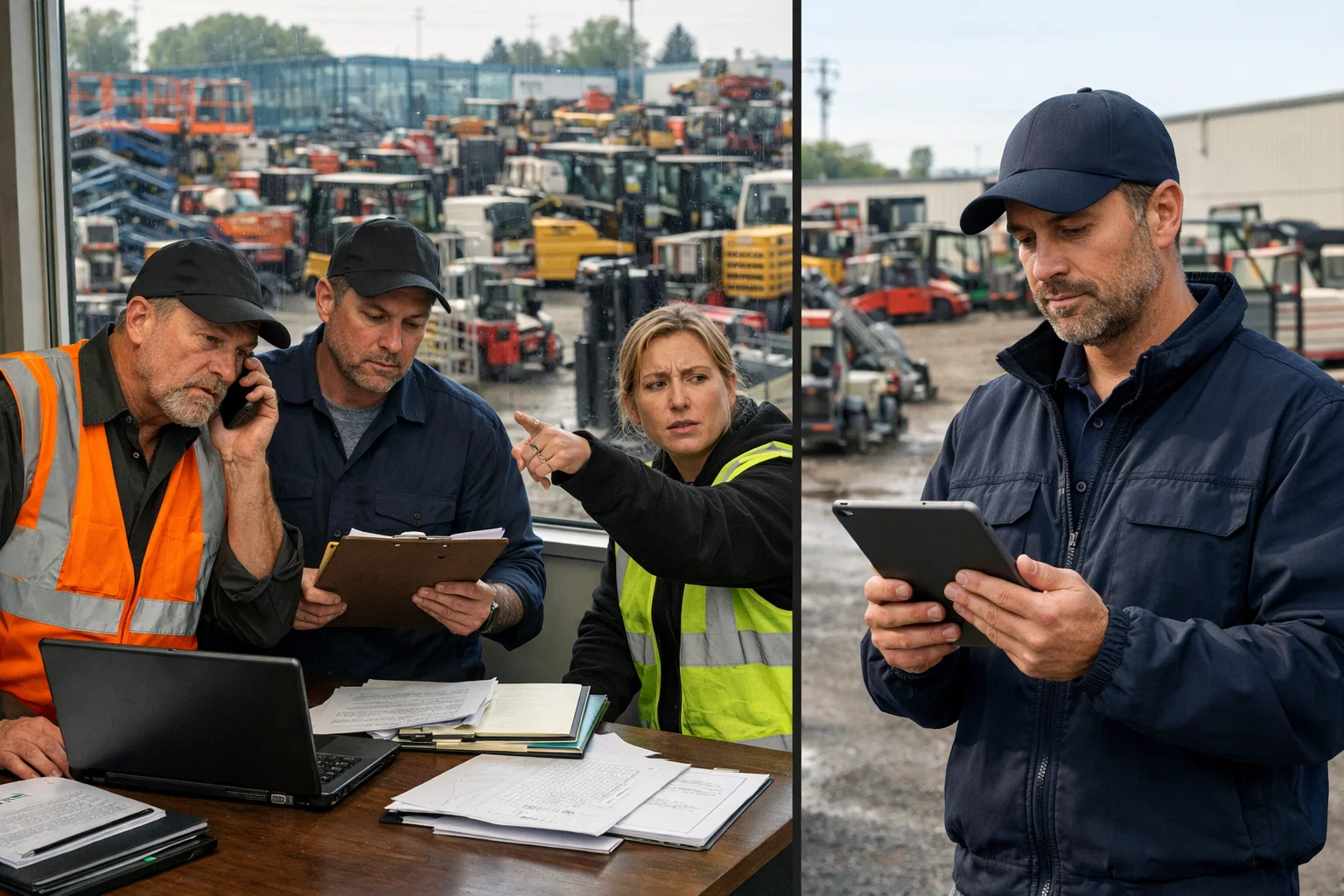
The Four Visibility Problems That Cost Equipment Rental Companies Every Day
As operations grow, the companies that hold up aren't always the ones with the most equipment. They're the ones who know where it is.
That sounds obvious. In practice, it's surprisingly rare.
When rental companies still rely on spreadsheets, handwritten notes, and phone calls to track their fleet, that clarity breaks down fast. Here's how and what fixes it.
Challenge 1: Nobody Actually Knows Where the Equipment Is
The problem
Locating a specific piece of equipment should take seconds. In most rental operations, it takes a phone call. Sometimes several.
Warehouse staff think certain items are in the yard. Dispatch assumes they're already on site. A driver remembers a delivery from last week but can't confirm whether it came back.
The daily result: staff interrupting each other for information, time spent physically walking the yard, and dispatch decisions made on assumptions rather than facts.
The fix
Every delivery and every collection gets recorded the moment it happens. The system always reflects where each item is, who has it, and when it last moved.
Any team member can check and get an immediate answer. Equipment location stops being a matter of memory and becomes something you can actually verify.
Challenge 2: Decisions Made on Yesterday's Information
The problem
Information delay is one of the most damaging problems in this business and the most underestimated.
Equipment leaves the yard in the morning. Records update hours later, sometimes not until end of day. In that window, dispatchers promise equipment that's already deployed. Warehouse teams prepare items that have already left. Customers get commitments that can't be honored.
None of this is caused by mistakes. It happens because information moves slower than equipment.
The fix
Delivery and collection teams log movements from the field on their phones. The moment something is recorded, the system updates. Warehouse, dispatch, and management all see the same information at the same time.
No lag. No version confusion. Just one picture of what's actually happening.
Challenge 3: Quantity Disputes With Customers
The problem
A customer says 20 barriers were delivered. Your records show 22.
Neither side is necessarily lying. The records are just incomplete. Resolving it takes time, creates friction, and can quietly damage a relationship that took years to build.
The fix
Quantities recorded at the moment of delivery or collection time-stamped, traceable. When a question comes up, both sides look at the same record.
What could have turned into a dispute becomes a two-minute admin check.
Challenge 4: Not Knowing How Much Inventory You Actually Have
The problem
Counting what's in the yard is manageable. The harder question is how much equipment is currently out on customer sites and when any of it is coming back.
Without clear movement tracking, rental companies operate on an incomplete picture. Jobs that could have been fulfilled get turned down. Jobs that can't be supported sometimes get accepted anyway.
Both cost revenue.
The fix
Warehouse inventory and deployed equipment live in the same system. As items move in and out, available inventory updates automatically. No periodic stocktaking needed to understand what you've got.
You can respond to customer requests with a real answer instead of an estimate.
What Solving This Actually Changes
All four challenges share the same root cause: a gap between what's happening in the field and what the rest of the organization can see.
Close that gap and several things improve immediately. Dispatch gets faster because decisions are based on accurate data. Inventory becomes reliable. Customer conversations get simpler because the records are clear. Management can actually see how the fleet is performing. And the business can grow without the operational chaos that usually comes with it.
The Point
Equipment rental is a movement business. Equipment goes from your yard to a customer's site and back again, constantly. Movement isn't the problem.
The problem is when information about that movement falls behind.
For rental companies trying to grow without drowning in operational noise, visibility isn't a nice-to-have. It's what everything else depends on.
If your team is still answering "where is the equipment?" with phone calls and spreadsheets, there's a better way. The difference between guessing and knowing usually comes down to one thing: live operational visibility.
Want to see how it works for your operation? Book a demo, get in touch, or try the platform free for 14 days, no strings attached.